Modern smart homes rarely start out fragmented. They become fragmented over time.
A new light here. A security camera there. Smart blinds added during a renovation. Each product promises convenience, and each arrives with its own app, login, update schedule, and way of working. Individually, they are fine. Collectively, they become a mess.
This is the core problem consolidation solves.
App fatigue is not just an inconvenience. It actively degrades how a home functions.
When every system lives in its own app:
Over time, homeowners stop using features entirely. Motion lighting gets disabled. Energy schedules are abandoned. Security alerts get ignored. The technology fades into the background, not because it works flawlessly, but because it is too frustrating to engage with.
A smart home that is not used is not smart.
Most reliability issues blamed on devices are actually system problems.
When each product operates in isolation, there is no single source of truth. One app thinks the lights are off. Another thinks the house is occupied. A third relies on an internet service that quietly failed overnight.
Because there is no unified logic layer, small failures cascade:
This is why fragmented smart homes feel unpredictable. Not because the technology is bad, but because it was never designed as a system.
Consolidation is not about buying fewer devices. It is about how they are controlled.
A consolidated smart home uses:
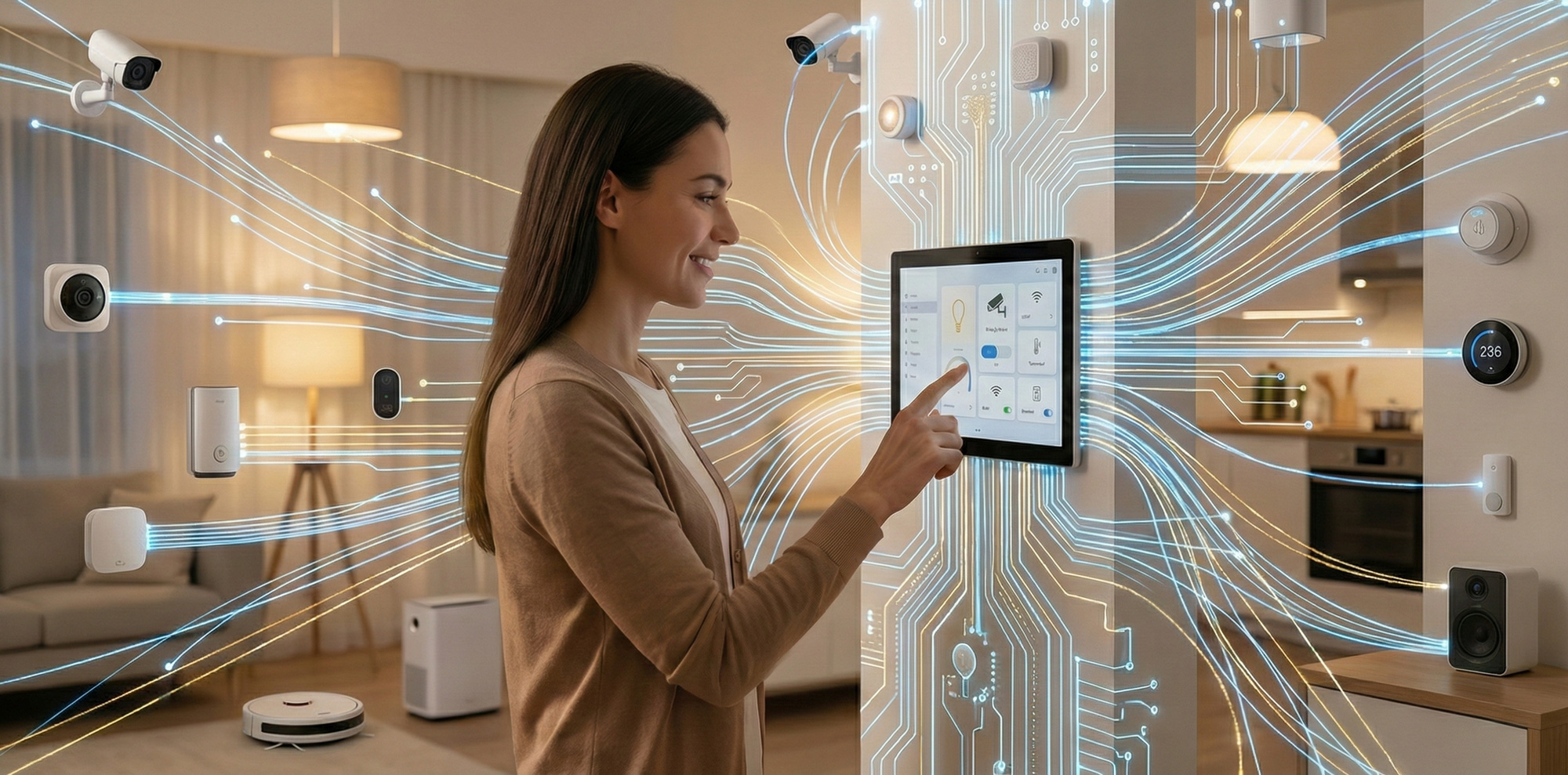
Lighting, climate, blinds, security, media, and energy monitoring all exist within the same framework. Automations are aware of each other. Conditions are evaluated once, not across multiple apps that never agree.
The result is coherence.
When a home runs on one system, the experience changes immediately.
Instead of thinking in terms of products, you think in outcomes:
There is no mental overhead. No app hunting. No wondering which brand controls which room.
Everyone in the household uses the system the same way, because there is only one way to use it.
Most app-based smart homes depend heavily on cloud services.
That dependency introduces risk:
A properly consolidated system prioritises local control. Automations run inside the home. Devices continue to function even when the internet is unavailable. Cloud access becomes optional, not essential.
This is the difference between convenience and resilience.
When problems arise in a multi-app home, support becomes a maze.
Each vendor points elsewhere. The electrician blames the app. The app blames the network. The network provider blames the devices. No one owns the outcome.
A consolidated system changes the support model entirely:
Troubleshooting becomes engineering, not trial and error.
Consolidation does not mean rigidity.
In fact, it is the opposite.
When devices are unified under an open, system-level platform:
This protects the homeowner from both obsolescence and vendor lock-in.
Many apps feel flexible in the beginning. One system feels deliberate.
Over time, deliberate wins.
A single, engineered smart home system delivers:
The technology fades into the background for the right reason. It works consistently, quietly, and predictably.
That is what a smart home is supposed to do.