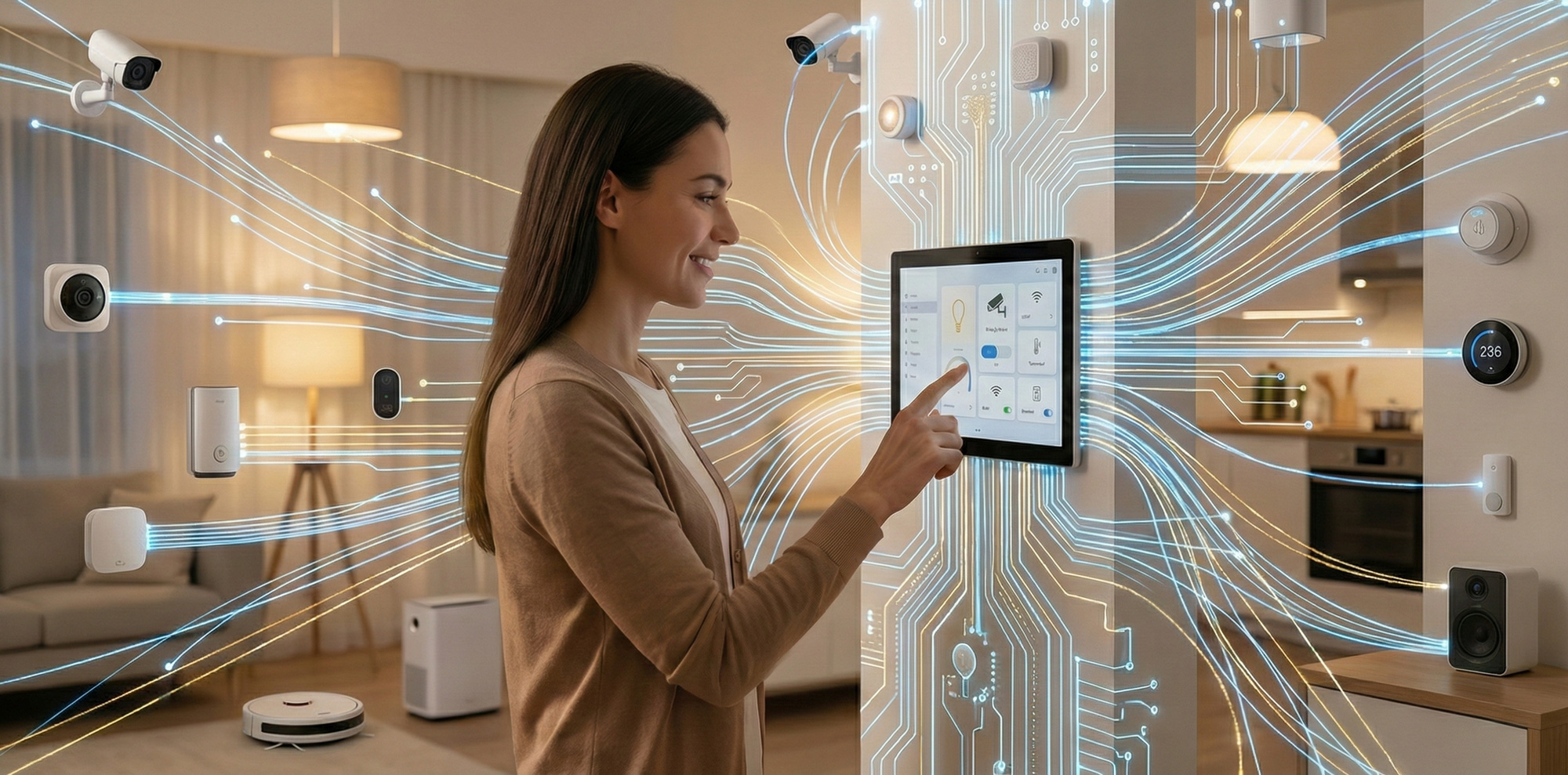
Walk into many modern homes and you will find plenty of smart devices — lights, blinds, cameras, speakers, climate control. On paper, everything looks advanced.
In reality, the experience often feels anything but smart. Lights do not respond when you expect them to. Automations work some days and not others. Wi-Fi drops out in the most inconvenient places. And controlling the home means juggling a growing collection of apps, accounts, and workarounds.
The problem is not that smart home technology does not work. It is that most smart homes were never engineered as systems.
A common misconception is that adding more smart products makes a home smarter. In practice, it usually creates fragmentation.
Each device arrives with its own app, its own logic, and its own limitations. Lighting lives in one place, climate in another, security somewhere else — with no single view of how the home actually operates as a whole.
When systems are not designed to work together, homeowners end up doing the integration manually, switching between apps and relying on memory instead of automation.
A smart home should feel unified and intuitive — not like a collection of unrelated gadgets.
Behind almost every unreliable smart home is the same silent issue: the network.
Wi-Fi is the foundation of modern home automation. If it is poorly designed, overloaded, or simply not suited to the building, everything built on top of it becomes unpredictable. Dropouts, delayed responses, and automations that "mostly work" are rarely device problems. They are symptoms of an underlying infrastructure that was never properly assessed or engineered.
No amount of clever automation can compensate for an unstable foundation.
Another common frustration appears after installation is complete. When something stops working, who owns the problem?
Electricians focus on wiring. IT contractors focus on routers. Product installers focus on the devices they sold. Each part may work in isolation, but no one takes responsibility for the system as a whole.
Without a single accountable expert overseeing design, integration, and long-term performance, small issues compound into ongoing frustration — and homeowners are left coordinating fixes themselves.
A smart home should reduce complexity, not create a new management role.
Homes that truly feel smart share a few consistent traits:
When technology is approached as a system — rather than a series of purchases — reliability improves dramatically. The home feels calmer, simpler, and easier to live with.
When a smart home is not behaving the way it should, replacing devices is rarely the right first step. A proper assessment identifies the root cause — not just the symptoms. By understanding how the network, devices, and automations interact, it becomes possible to resolve instability at its source and create a foundation that supports the home for years to come.
Smart homes do not need more technology. They need better engineering.